This post connects cryptographic primitives to system-level trust. The core idea is simple: secure primitives are necessary but not sufficient; operational details determine whether those primitives actually deliver confidentiality, integrity, authentication, and non-repudiation.
Why This Layer Matters
Packet-level attacks show that identity can be forged at lower layers. Cryptography is the mechanism that upgrades trust from “looks valid” to “is verifiably bound to a secret or a key pair.” But each layer introduces design choices that can fail in practice: weak randomness, poor key lifecycle handling, and broken validation logic.Symmetric Cryptography: Fast but Fragile Under Misuse
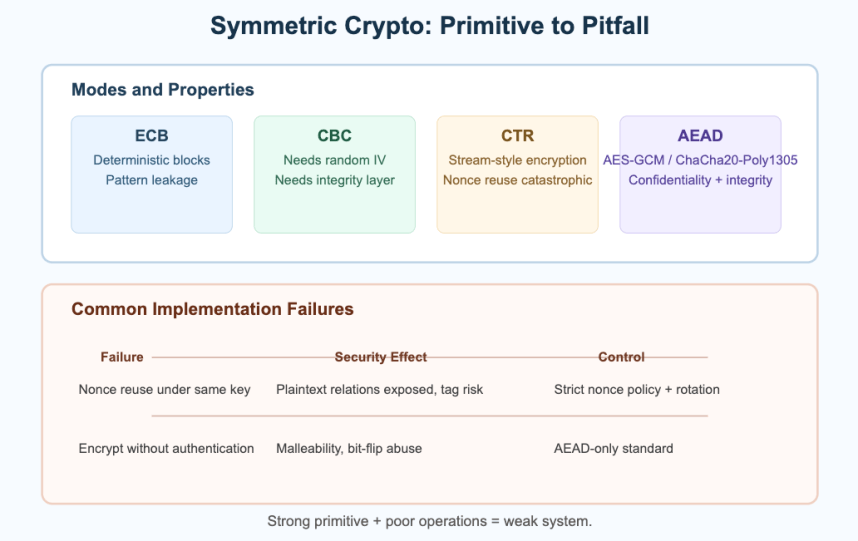
Symmetric encryption is efficient and central to bulk data protection. The same key encrypts and decrypts, which makes key distribution the first challenge. Once deployed, the biggest risk is not usually “weak algorithm” but misuse of modes, nonces, IVs, and authenticity controls.Block cipher mode implications
- ECB leaks structure and should not be used for sensitive structured data.
- CBC can protect confidentiality but needs unpredictable IVs and separate integrity protection.
- CTR transforms a block cipher into a stream construction and fails catastrophically if nonce/counter reuse occurs.
- GCM and ChaCha20-Poly1305 provide AEAD and are preferred for modern transport/application protection.
Operational failure patterns
- Key reuse across environments (dev/test/prod) causing blast-radius expansion.
- Nonce reuse under the same key leading to plaintext recovery or tag forgery risk.
- Encrypt-without-authenticate designs enabling bit-flipping and malleability abuse.
Public-Key Cryptography: Solving Distribution, Adding Identity
Public-key systems separate encryption and decryption capabilities and enable digital signatures. This supports two essential properties that symmetric systems alone cannot provide cleanly at scale: flexible key establishment and verifiable origin authentication.Core roles
- Key exchange/agreement to derive ephemeral session keys for symmetric bulk encryption.
- Signatures for authenticity and integrity with non-repudiation semantics under policy.
- Certificate-bound identity so peers can validate “who owns this public key”.
Critical distinction
Encryption answers “who can read this?” while signatures answer “who produced this?” Secure protocols need both dimensions, and confusion between them is a frequent design error.Hybrid Design Pattern: Why Real Protocols Combine Both
In production protocols, public-key operations are used sparingly because they are computationally expensive. Typical flow: authenticate and establish shared secret using asymmetric methods, then protect sustained traffic with symmetric AEAD. This hybrid design is exactly what modern TLS and VPN systems rely on.Security property mapping
- Confidentiality at scale: symmetric session keys.
- Peer identity: certificate + signature validation.
- Forward secrecy: ephemeral key exchange and strict key disposal.
- Tamper detection: authenticated encryption tags and transcript binding.

PKI: Turning Keys into Trust Decisions
PKI provides the policy and infrastructure layer that binds identities to public keys. Certificates, trust stores, and validation logic convert raw cryptography into deployable trust decisions.Validation chain requirements
- Certificate chain builds to a trusted root in the verifier trust store.
- Hostname or service identity matches certificate subject/SAN constraints.
- Validity period and algorithm constraints are enforced.
- Revocation status is checked where policy requires (CRL/OCSP/short-lived cert strategy).
PKI risk realities
- CA mis-issuance can undermine large trust domains.
- Overly broad trust stores enlarge attack surface.
- Operational lag in revocation and rotation weakens incident response.
| Failure Mode | Impact | Mitigation |
|---|---|---|
| Nonce reuse in AEAD | Confidentiality/integrity collapse for affected key scope | Strict nonce generation policy and key rotation controls |
| Missing certificate hostname validation | MITM acceptance with valid but wrong cert | Enforce SAN/CN checks in client validation path |
| Weak key lifecycle governance | Key compromise persistence and broad blast radius | Automated rotation, HSM/secret boundary controls, audit trails |
| Encrypt-without-authenticate pattern | Malleability and message forgery opportunities | Use AEAD by default and ban legacy unauthenticated modes |
Engineering Checklist for Real Deployments
- Default to AEAD (`AES-GCM` or `ChaCha20-Poly1305`) with explicit nonce management guarantees.
- Separate long-term identity keys from ephemeral session material.
- Require complete certificate and hostname validation on every client path.
- Automate certificate issuance and renewal to reduce manual trust failures.
- Instrument key usage, failed validations, and revocation events for monitoring.
- Test downgrade resistance and algorithm policy enforcement continuously.
Key Takeaways
- Symmetric crypto gives performance; asymmetric crypto gives scalable trust relationships.
- Most breaches occur from misuse and operations, not from breaking modern primitives directly.
- PKI is the decisive layer that turns keys into identity decisions.
- Security outcomes depend on lifecycle controls: generation, storage, rotation, validation, and revocation.