This capstone post analyzes an end-to-end privacy attack pipeline: passive TLS metadata collection, behavioral modeling, live prediction, and mitigation impact using ECH.
.
Threat Model and Objective
The attacker is passive on the victim network path and cannot decrypt TLS payloads. Objective: infer user intent and likely next destinations from observable handshake metadata..
Part 1: The Obvious Leak
TLS Server Name Indication in ClientHello can reveal destination hostnames when not encrypted. Capture plus parser extraction yields browsing traces without breaking cryptography.- Capture raw packets on attacker vantage point.
- Extract SNI fields and timestamps from observed handshakes.
- Construct per-session sequences from timing boundaries.

.
Part 2: The Deeper Leak
Sequence-level modeling enables behavior inference. A classifier identifies persona-like browsing patterns, then a Markov-style predictor estimates likely next destinations from recent observations.Model stages
- Stage A: classify sequence context using early discriminative domains.
- Stage B: predict next destination distribution from current state transitions.
- Stage C: trigger adversarial preparation actions (for example, pre-built phishing pages).
.
Data and Evaluation Design
- Structured session generation with labeled personas and transition weights.
- Train/validation split for classifier and predictor quality measurement.
- Metrics: top-1, top-3, baseline comparison, confusion patterns.
- Live test with fresh sessions to evaluate real-time inference behavior.
| Attack Stage | Input Signal | Attacker Capability Gained |
|---|---|---|
| SNI extraction | ClientHello metadata | Destination visibility without payload decryption |
| Session classification | Early sequence tokens | User behavior profile inference |
| Next-site prediction | Transition model state | Pre-emptive social engineering preparation |
.
Part 3: Mitigation with ECH
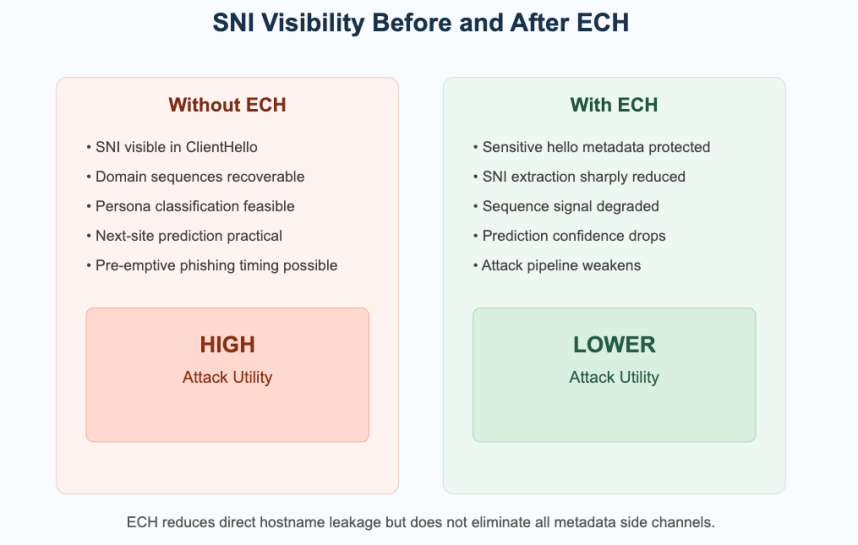
Encrypted ClientHello is designed to hide sensitive handshake fields, including SNI in supported contexts. When enabled in the tested workflow, passive extraction loses direct hostname visibility and the attack pipeline degrades sharply.- Capture still sees packets, but key metadata signal quality drops.
- Sequence reconstruction becomes sparse or ambiguous.
- Classifier/predictor confidence and utility decline significantly.
.
Limitations and Real-World Constraints
- ECH effectiveness depends on client, server, and resolver ecosystem support.
- Other metadata channels (timing, IP destinations) remain partially informative.
- Model performance can drift with user behavior or domain ecosystem changes.
.
Defensive Recommendations
- Adopt ECH-capable stacks as support matures.
- Reduce passive observer opportunities through segmentation and secure access design.
- Monitor outbound destination behavior for anomaly and impersonation signals.
- Train users and systems against pretexted credential capture workflows.
.
Key Takeaways
- Transport encryption alone does not eliminate privacy leakage from metadata.
- Sequence modeling turns small leaks into high-value behavioral inference.
- ECH is a meaningful mitigation, but must be part of a layered privacy strategy.